If you manage a commercial pool in the UK, you already know that PWTAG guidance is the standard everyone works to. The HSE recognises it, local authority Environmental Health Officers enforce against it, and if something goes wrong, it is the benchmark a court will measure you against.
But the PWTAG Code of Practice is a big document, and the full Swimming Pool Water book runs to hundreds of pages. When you are standing in a plant room at 7am trying to remember whether you need to test alkalinity today or next week, you need something shorter.
This is that shorter thing. A practical, no-nonsense checklist covering what you actually need to do, how often, and what the acceptable ranges are. It is based on PWTAG guidance and HSG179 requirements, written by someone who uses this stuff every day rather than someone who read about it.
Water quality testing: what to test and when
Every session (before opening, then every two hours during use, and after closing)
These are your core poolside tests. If you are not doing these, you are not compliant. Full stop.
Free chlorine: The target depends on your setup, but for most pools using sodium hypochlorite with a pH of 7.2, you are aiming for between 0.5 and 1.0 mg/L. Never let it drop below 0.5 mg/L. If it goes above 3.0 mg/L, stop dosing and consider closing the pool until levels come down.
Combined chlorine: Should be less than half of your free chlorine reading, and never more than 1.0 mg/L. High combined chlorine means your disinfection is being used up faster than it is being replaced, usually because of heavy bather load or inadequate ventilation.
pH: For chlorine-disinfected pools, keep this between 7.2 and 7.4. Higher pH reduces chlorine effectiveness, so if your pH drifts up, your free chlorine is doing less work than the number on your test kit suggests.
Temperature: Record the water temperature at each test. This matters for compliance records and also affects how your chemicals behave. Warmer water needs more attention.
Daily
Automatic controller check: If you have automatic dosing and monitoring equipment, check it daily against a manual test to make sure the readings match. PWTAG recommends that if the difference between the controller and your manual test is more than 15%, the controller should be recalibrated.
Visual inspection: Check water clarity, pool surround cleanliness, and that all safety equipment is in place. This is not just good practice, it is part of your duty of care under HSG179.
Weekly
Alkalinity: Should sit between 80 and 200 mg/L. Alkalinity acts as a buffer for your pH, so if your alkalinity is wrong, your pH will be unstable no matter how much acid or alkali you add.
Calcium hardness: Aim for between 75 and 150 mg/L, though this can be very difficult in hard water areas. If you are consistently above 300 mg/L, you will start seeing scale build-up on surfaces and equipment.
Total dissolved solids (TDS): Keep below 1,000 mg/L. Use a calibrated electronic meter, not guesswork. High TDS causes all sorts of problems and the only real fix is dilution with fresh water.
Sulphates: Less than 360 mg/L. Test weekly.
Water balance (LSI calculation): The Langelier Saturation Index brings together pH, alkalinity, calcium hardness, TDS, and temperature into a single number that tells you whether your water is corrosive or scale-forming. Calculate this weekly at the same time as your other tests.
Monthly
Microbiological sampling: This is the one that a lot of operators either forget about or avoid because it means sending samples to a UKAS-accredited laboratory. But PWTAG is very clear on this: all swimming and spa pools should be tested monthly for aerobic colony count, coliforms, E. coli, and Pseudomonas aeruginosa.
For hydrotherapy pools, the requirement is weekly, not monthly.
Samples should be taken with the pool in use, ideally when it is busy or immediately after a heavy session. Take the sample from the deep end, away from inlets.
What the microbiological results should look like
Aerobic colony count (TVC): Less than 100 cfu per mL. Anything above this suggests your disinfection and filtration are not working properly.
E. coli: Should not be detected in a 100 mL sample. If you find E. coli, you have had faecal contamination. No exceptions, no excuses.
Total coliforms: Ideally undetected in 100 mL. A one-off result under 10 cfu per 100 mL is not necessarily a crisis, but repeated results need investigating.
Pseudomonas aeruginosa: Should not be detected in 100 mL. If you get a reading between 10 and 50 cfu per 100 mL, check your pH and free chlorine, clean your filters, and retest. Above 50 cfu per 100 mL, close the pool. Pseudomonas loves biofilm, so check pool covers, inflatable equipment, and any flexible hoses or fittings.
Record keeping
This is where a lot of operators fall down during inspections. The testing itself might be fine, but if you cannot produce the records to prove it, you have a problem.
PWTAG and HSG179 expect you to keep records of every water test, the results, and any corrective actions taken. These records need to include the date and time, who took the sample, which pool, and all the parameter values. If a reading was out of range, you need to document what you did about it and when you retested.
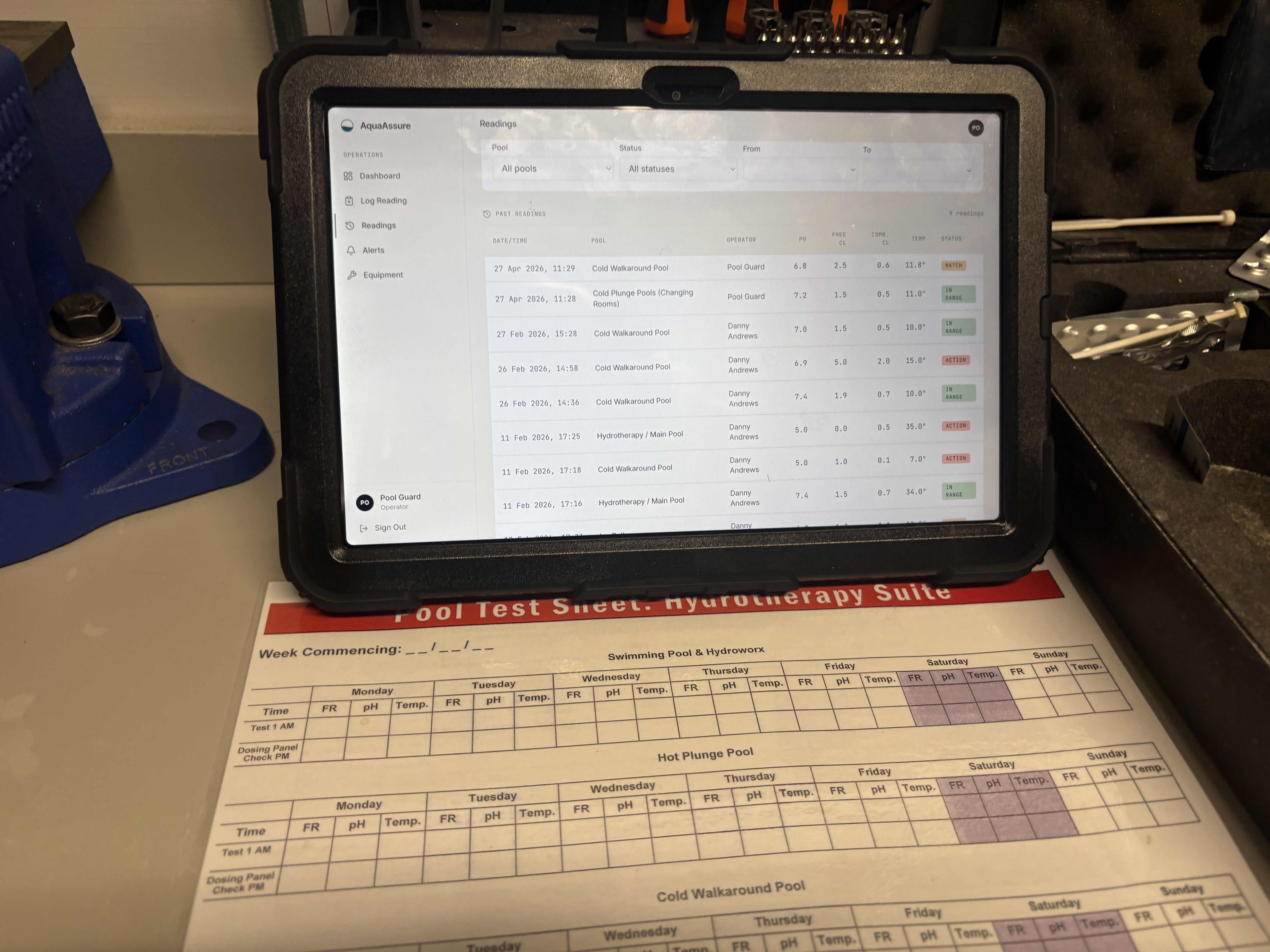
Paper logbooks work, but they come with risks. Illegible handwriting, lost sheets, coffee stains, and the general chaos of trying to find a specific reading from three months ago when an EHO is standing in your office. Digital records solve most of these problems, as long as the system is designed for pool operators rather than adapted from something else.
Your records also need to include details of any contamination incidents (faecal releases, blood, vomit), what your response was, how long the pool was closed, and the test results before reopening.
Equipment maintenance and PPM
Water testing is only half the picture. PWTAG also expects you to maintain your plant and equipment properly.
Filters: Should be backwashed according to the manufacturer's schedule and the pressure differential readings. Keep records of every backwash including date, duration, and any issues noted.
Dosing equipment: Check calibration regularly. Automatic dosing systems are brilliant when they work, but they fail silently. If your controller drifts out of calibration and you are not checking it against manual tests, you could be over or under dosing for days without knowing.
Circulation pumps: Monitor flow rates and record them. A drop in flow rate usually means a filter problem, a valve issue, or a pump starting to fail. Catch it early.
UV or ozone systems (if fitted): These need regular maintenance and lamp replacement. Keep records of lamp hours and replacement dates.
Staff training and competence
PWTAG expects that pools are managed by competent people. For larger facilities, this means having a Swimming Pool Technical Operator (SPTO) who has completed PWTAG-accredited training. For smaller facilities with visiting technical operators, the guidance requires a minimum of weekly visits with written documentation.
At a minimum, anyone taking water samples and recording results should know what the acceptable ranges are, what to do when a reading is out of spec, and when to escalate to someone more senior.
What an EHO inspection actually looks for
When Environmental Health Officers visit, they are not just checking your water quality. They are looking at:
- Whether your records are complete, legible, and up to date
- Whether out-of-range readings were followed up with corrective action
- Whether your risk assessment is current
- Whether your staff are trained and competent
- Whether your plant and equipment are properly maintained
- Whether your emergency procedures (contamination response, pool closure criteria) are documented and understood by staff
Having all of this in order is not just about passing inspections. It is about being able to demonstrate, at any point, that you are running a safe facility. If something goes wrong, your records are your defence.
How AquaAssure helps
We built AquaAssure because we got tired of managing all of this on paper. It is a pool operations platform designed specifically for UK commercial pool operators, built around PWTAG and HSG179 requirements.
Every water test is logged digitally with automatic range checking. If a reading is out of spec, the system flags it immediately and prompts you to record your corrective action. Your compliance history is always available, searchable, and audit-ready.
It also handles equipment maintenance scheduling, chemical inventory tracking, and compliance reporting, so everything sits in one place rather than spread across paper logbooks, spreadsheets, and someone's memory.
If you are still managing pool compliance on paper, book a demo and see how it works. It was built by a facilities manager, tested at a Premier League academy, and designed for people who actually do this job every day.